
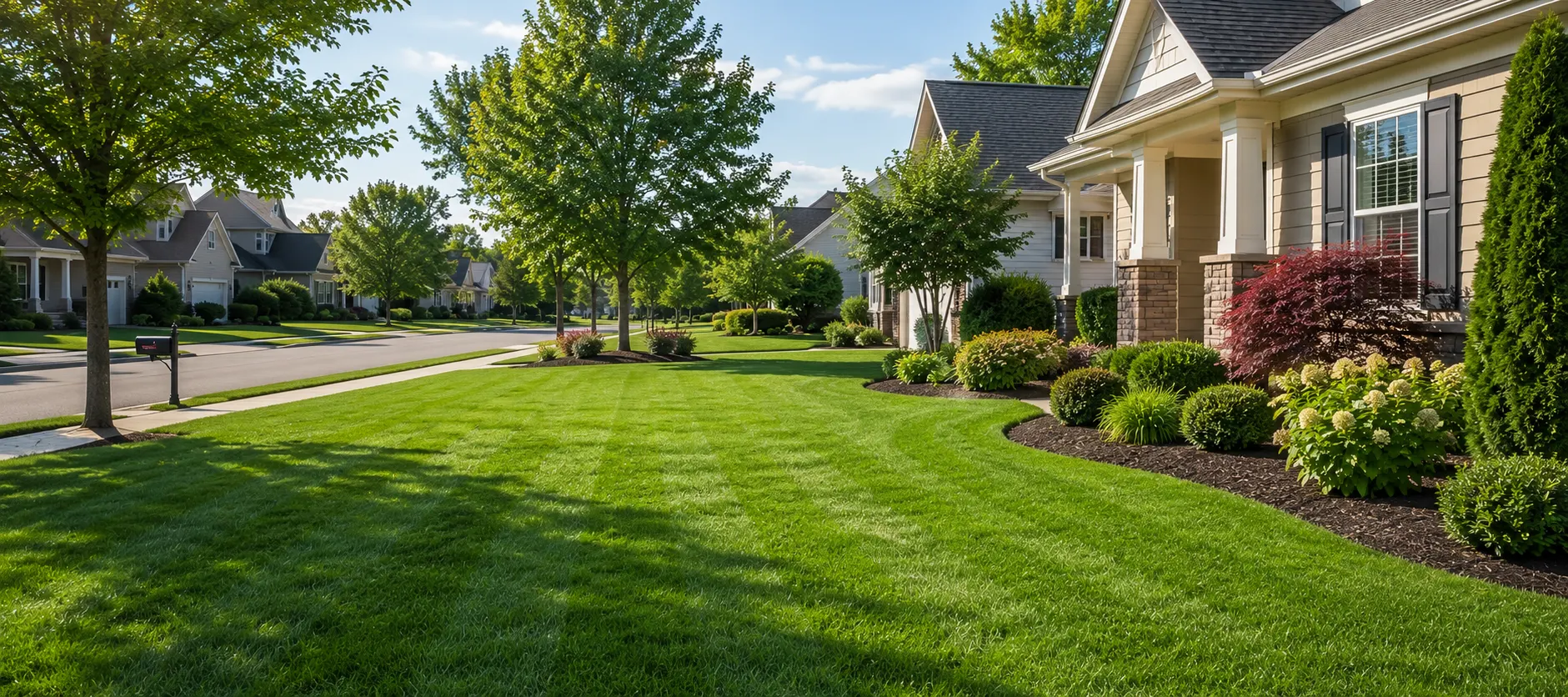
Core aeration & overseeding
Core lawn aeration for Jefferson and Loudoun County.
Aeration is the highest-return hour anyone spends on a cool-season lawn — and the one job where doing it in the wrong month wastes the entire effort. Here is what it does, when it works, and how we run it on both sides of the Blue Ridge.
What we do
What coring does that nothing else does.
A core aerator drives hollow tines into a lawn and pulls out thousands of finger-sized plugs of soil and thatch, leaving them on the surface to break down. Every hole it opens is a channel: air, water, and roots move down into ground that had sealed itself shut, and new seed can land against bare soil instead of perching on top of an established stand. Nothing else reproduces that. Spike units, which punch holes without removing anything, shove soil sideways and leave the ground tighter than they found it. Coring is also what the rest of our mechanical turf work hangs on — overseeding takes best the same day the holes are open, compost top-dressing finally has somewhere to go, and dethatching clears the way first when a heavy mat has sealed the surface.
- Hollow-tine coring that pulls real plugs
- Turf-type tall fescue overseeding
- Compost top-dressing to rebuild soil
- Dethatching when a mat has formed
- Mechanical work only — no chemical programs
- Ballpark range within two business days
Why it matters
Why clay soil closes up here.
Nearly every established lawn between Charles Town and Ashburn is a turf-type tall fescue stand growing in soil with a lot of clay in it. Clay isn't the enemy — it holds water and nutrients far better than sand ever will — but it collapses under traffic, and once the top few inches pack down everything above ground starts telling on it. Water sheets off instead of soaking in. Roots stall at two or three inches. The lawn looks fine through a wet June and then browns out in the first serious dry stretch of August. Throwing more seed on top doesn't fix any of it, because the seed never reaches soil and the roots never reach depth.
Fall is when the fix takes. Cool-season turf here spends late August through October putting its energy into roots rather than blades; the soil is still warm enough to germinate seed while the air has cooled enough to keep seedlings from cooking, and rainfall is more dependable than it was in midsummer. Core a lawn inside that window and the holes close over the winter with roots in them. Core the same lawn in May and you buy a month of improvement before summer takes it back. Where a lawn is too far gone for coring and seed to carry it, the honest answer is a full lawn renovation instead — and we'll tell you that rather than sell you the smaller job twice.
Two service areas
Same equipment, two different problems.
The machine and the standards don't change from one county to the next. The ground does — enough that we treat them as two separate conversations. Pick the page that matches your property and you'll get the specifics that actually apply to it.
Charles Town, WV & Jefferson County
Established lawns compacted by years of ordinary use, mature shade thinning the turf under old canopies, and a fall window that opens a touch earlier than it does across the river in Virginia.
Aeration in Charles Town, WVAshburn, VA & Loudoun County
Heavy clay, subsoil pressed flat during construction, and HOA-dense neighborhoods of townhomes and tight side yards where timing and cleanup matter.
Aeration in Ashburn, VAPricing
Quoted per property, never off a chart.
Aeration pricing follows square footage first, then how many passes the ground needs, then whether overseeding and compost top-dressing come along with it. Access counts as well — narrow gates, terraced beds, and real grade all slow a machine down. We don't publish a flat per-thousand-square-foot rate, because the properties we work run from townhome yards to multi-acre lots and a single number would be wrong for most of them.
Send photos through the Insta-Quote form and you'll have a ballpark range within two business days, confirmed precisely on-site before anything gets scheduled. If coring and seed will get you where you want to be, that's the recommendation you'll get.
Get an Insta-QuoteOther services
You may also want to look at.
- 01
Landscape Design & Install
Plans drawn — and planted — for the way your family actually lives outside. - 02
Mulch & Landscape Maintenance
Mulch, flower-bed care, and shrub trimming — dedicated bed and shrub work that leaves a property sharp. - 03
Lawn Renovation
Aeration, overseeding, dethatching, and compost top-dressing.
Common questions
About this service.
Don't see your question? Reach out — you'll get a ballpark range within two business days.
How often should a lawn be aerated?
Once a year for most lawns in this region, in the fall. Heavy clay, high-traffic yards, and anything built on compacted construction ground earn it annually without exception. A lighter, well-drained soil carrying a healthy stand can sometimes stretch to every other year.
Is core aeration better than spike aeration?
Yes, and it isn't close. Spikes push soil aside and add compaction around every hole they make. Hollow tines remove a plug and give the surrounding soil somewhere to expand into. When you compare aeration quotes, it's worth asking which of the two each one actually covers.
Should I overseed at the same time?
Almost always. Open core holes are the best seedbed you will get without stripping a lawn to bare dirt, and the window for coring and the window for seeding are the same few weeks. The exception is a thick, healthy stand that has simply gone tight in the soil — that lawn needs the holes, not the seed.
Can I aerate in the spring instead?
You can, and on badly compacted ground spring coring does relieve some of the tightness. What doesn't work is spring seeding: new grass heads into summer with a shallow root system and most of it is gone by July. If the goal is a thicker lawn, wait for fall.
Do the plugs need to be cleaned up?
No — leave them where they land. The cores carry soil biology back onto the surface and break apart within two to three weeks, faster after a decent rain. Raking them off discards most of what the visit was for.
Do you serve my area?
We work Jefferson County, West Virginia and Loudoun County, Virginia, and each job is scheduled on its own and travelled to individually, so an address further out isn't automatically a problem. The two area pages below cover what changes from one side of the Blue Ridge to the other.